Why Kaiut Yoga
The method
came from
someone
in pain.
Francisco Kaiut was shot in the hip as a small boy. The pain stayed with him for most of his life. Everything he built came out of trying to get out of it.
He went looking, the way people in pain go looking. Alternative therapies. Every kind of bodywork he could find. At fifteen he found yoga, and at seventeen he opened his first school, which tells you something about how much of an answer it felt like.
But the yoga he had been handed was designed for a different body in a different century. So he spent years taking it apart and rebuilding it around the body people actually walk in with now: a body that sits, that repeats the same handful of movements all day, that has been carrying an old injury for thirty years and has quietly organised itself around it.
The method came out of that work. It was effective on a small group of students before it had a name, and he kept refining it. He now leads the Kaiut Yoga group and directs the teaching across eighteen schools between Brazil and the United States, and he still writes the education those schools run on.
“We need to move the body in the most intelligent way, not the toughest or most intense way.”
What that means once you are on the floor
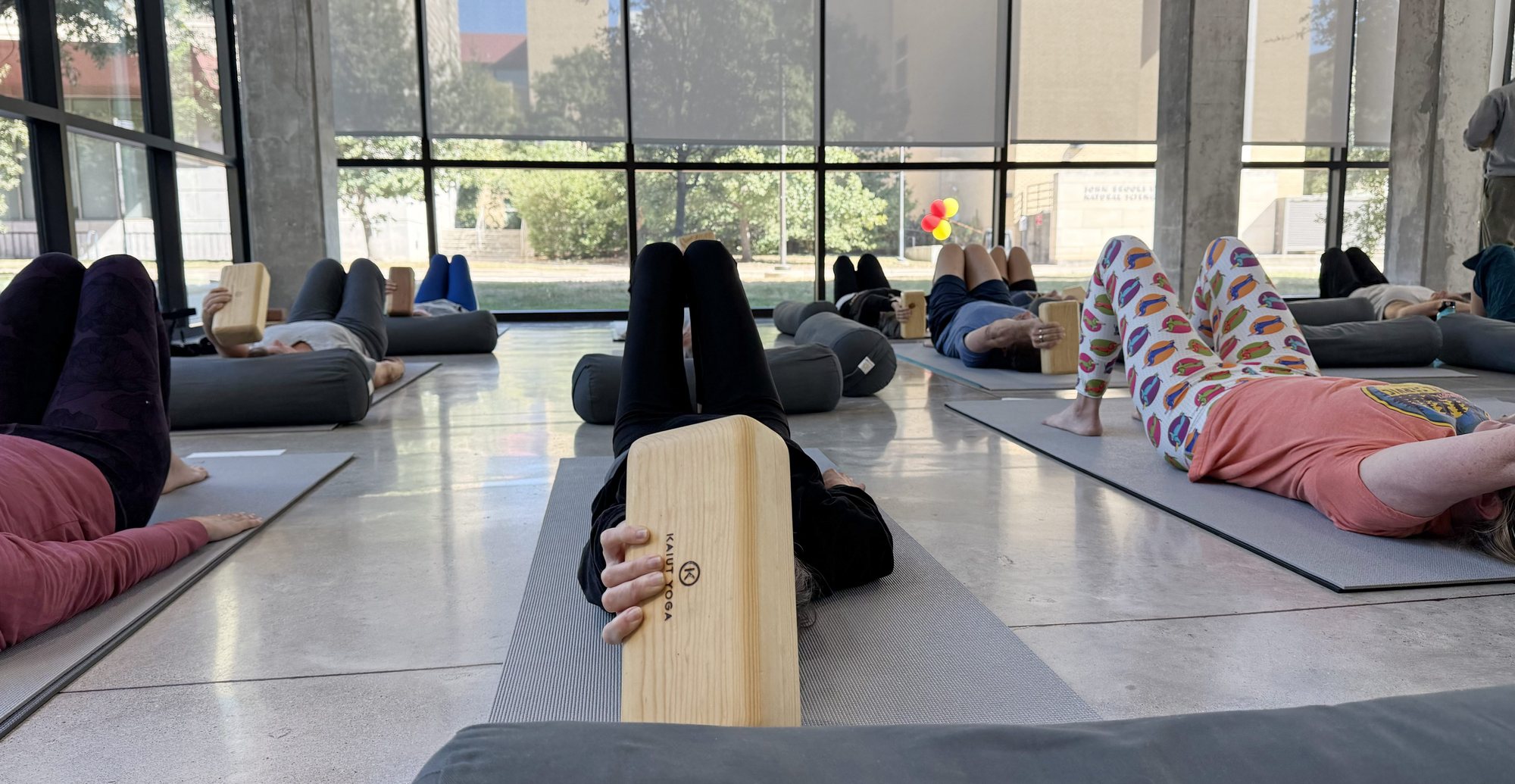
It means the class is not built around what a position looks like. It is built around what a joint needs in order to send better information back to the brain. You will work one joint at a time, in positions held long enough to matter, with a bolster or a wall or the floor doing the work of holding you there.
Nothing about it is impressive to watch. Range of motion is not the score. A body that communicates better with itself is the score, and that turns out to be the thing that gives you the stairs back, and the seatbelt, and the night’s sleep.
It also means the practice does not need you to be flexible, young, athletic or experienced first. The people who arrive most restricted are usually the ones who notice the most change.
The school in Austin
Kaiut Yoga Austin is the licensed Kaiut school for Austin, not a studio that added a class to its timetable. Renae Molden teaches nearly every class on the schedule herself, and she keeps studying inside the same ongoing education Francisco writes for every school in the group.
That is the whole reason the method arrives here intact rather than diluted into something more familiar.